


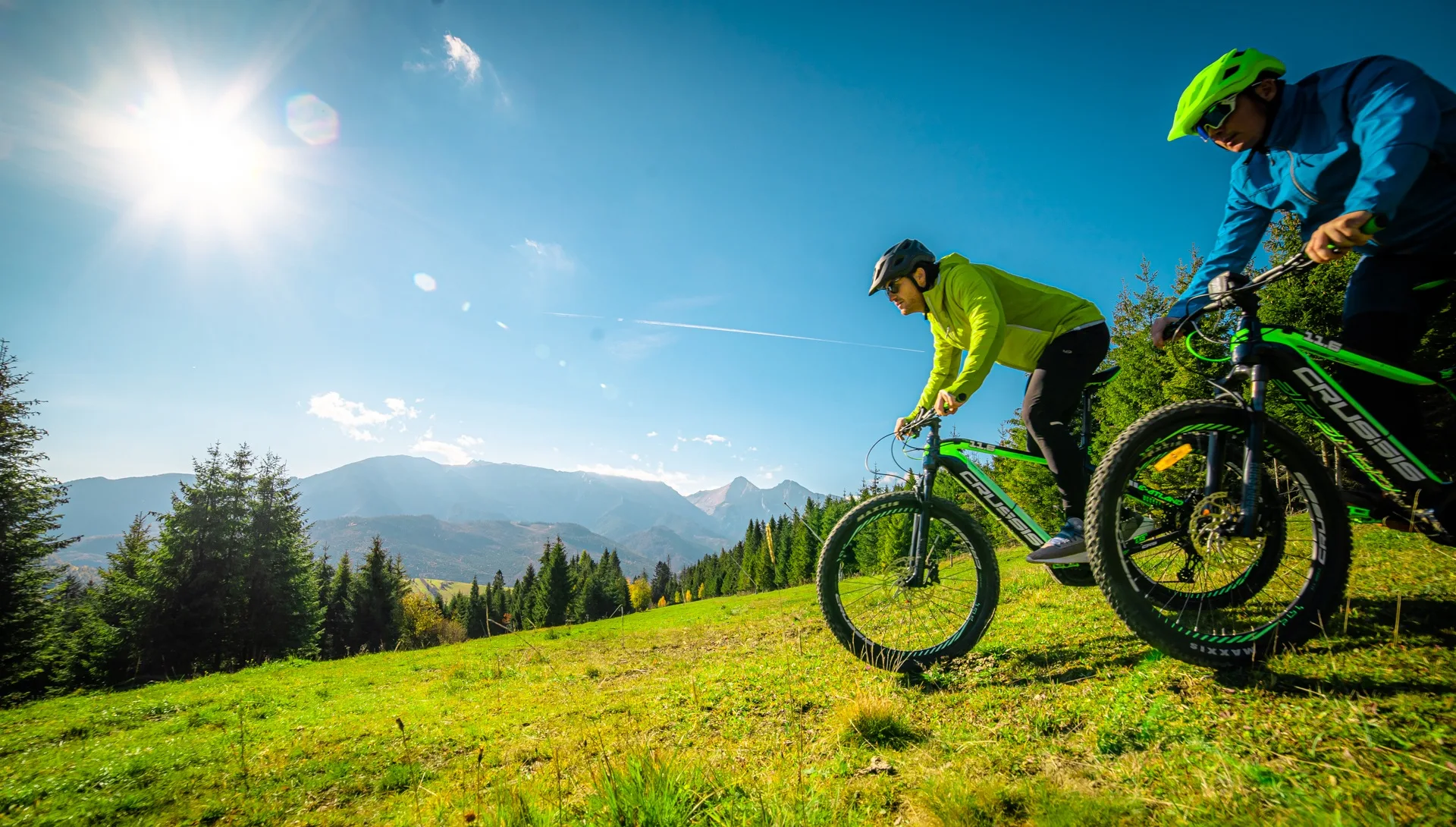
In the last blog we learned about the options for getting to us by bike. And especially if you already have a few kilometres in your legs, after arriving at the BACHLEDKA we will comfortably take you and your bikes up the 10-seater cable car to the top of Spišská Magura. Once on the ridge, it is up to you to decide whether your adventure will continue with bird’s-eye views of the surrounding nature from the Treetop Walk, or whether you will choose one of our other attractions. Today, we will learn how to be well prepared for a cycling trip.
Clothing
In recent days, we have been enjoying intense sunshine and fewer sudden summer storms that come with it. Such weather changes are very common at this time of year, and the mountain environment only magnifies their unpredictability. Dressing properly is essential for family cycling trips, adrenaline-fuelled forest biking and city cycling alike.
It is worth following the layering principle used for classic hiking and choosing functional materials. The functionality of clothing is primarily based on three key properties: breathability, water resistance and wind resistance. Each layer should have its own properties, but the individual layers are a topic in themselves. It is important to know the materials and choose ones that keep our bodies at an optimal temperature, regardless of the difficulty of the activity we are doing.
Clothing should be breathable and wick body moisture away, while also preventing cold and damp from reaching the body. You should choose your clothing carefully, because the right clothing ensures that your body neither overheats nor becomes chilled. Functional materials include merino wool and Deltapeak fabric.
The same rule applies: “more is better than less”. So pack some clothes to change into, a waterproof layer with a hood, waterproof shoe covers and waterproof trousers. And above all, remember – everything should be functional.
Accessories and safety equipment
“What if I get a flat tyre? I’d rather not go cycling at all.” Forget the excuses – there is always a solution. Basic cycling service equipment includes a small puncture repair kit, two tyre levers for removing and putting the tyre back on the wheel, and a pump. Alternatively, pack a new inner tube of the required size and simply replace the punctured one with it.
Of course, the golden rule is to wear a helmet. Always and everyone. If you feel that it does not fit securely, wear a functional headband or cap underneath. It is also very important to pack sunscreen. Also bring sunglasses, which can be cycling-specific, but do not have to be. The important thing is that they protect your eyes from strong sunlight, so they should have a UV filter and may also be polarised. Even the most ordinary ones will protect you from insects.
They may seem like a detail to some, but reflective elements play an important role. Reflective vests must also be worn on main roads. Lighting is not only essential, but also required by law: a white light at the front, a red one at the back. Gloves are another useful accessory. Your sweaty hands will not slip on the handlebars, and the gloves will also protect you from unpleasant abrasions. They are also available with gel padding.
Cycling with children
A child trailer is a great helper for family adventures, for example one by Thule, which can be adapted for cycling as well as used as a sports stroller. Double versions are also available. This way, you can enjoy time in nature together with your children.
Handling these bike trailers is really easy, and the staff in shops will advise you on how to attach them to your bike. Bike bags are also very practical. When choosing them, you should also consider how they attach to the bike. There are various brands, and each has its own attachment system. We recommend buying a waterproof version straight away.
Staying hydrated
If anything is as important as a helmet, it is staying hydrated. You can carry a water bottle in a classic bottle holder mounted directly on the bike frame. Alternatively, you can get a sports backpack with a capacity of 2–5 litres, which can hold an aquabag (a rubber water bladder with a drinking tube). It is very practical: a lightweight sports backpack with a tube that is just long enough for you to drink easily whenever you need to.
Before setting off on a cycling trip
Now that we know the route and have some basic information on how to prepare properly for a cycling trip, there is just one final piece of advice before setting off. On hot summer days, it is better to set off early in the morning, while temperatures are still lower. We have already covered safety equipment, but it is also very important to respect traffic and its rules, and to cycle responsibly. Finally, after returning home, remember to let your muscles recover.
Packing checklist
- shorts and a T-shirt made of functional material
- a functional sweatshirt that will also keep you warm in the morning or evening
- a breathable, waterproof and windproof jacket
- reflective elements
- a helmet
- a small repair kit with a pump
- water